



You arrive at the bus stop and open up the MTA app on your phone. The next bus is four minutes away. Then one minute. Then zero minutes. The bus that never arrived has somehow already departed. Now it's disappeared from the map entirely.
Mayor Zohran Mamdani made "fast and free" bus service a cornerstone of his campaign, and in doing so highlighted a complicated, long-neglected problem for the 1.4 million New Yorkers who ride the bus every day: bogus bus arrival times.
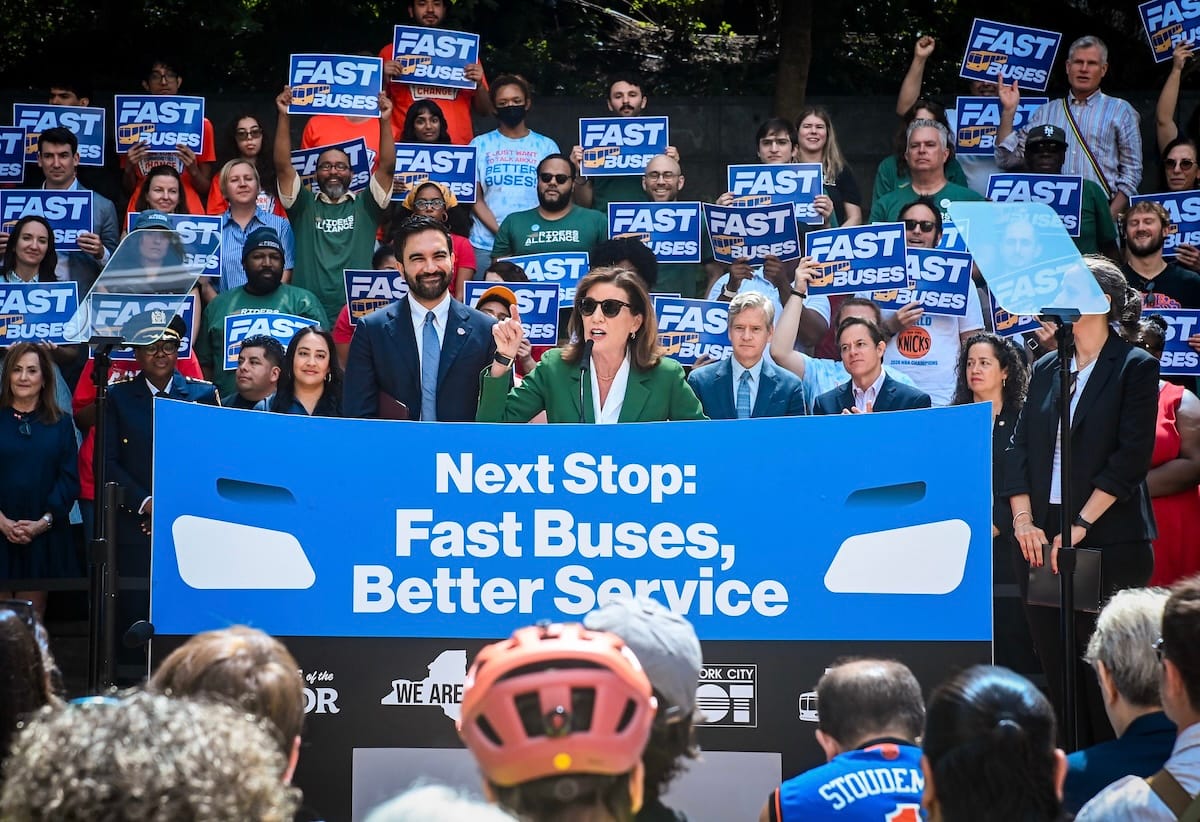
"Riders shouldn't have to wonder if they'll make it to work, school or a doctor's appointment on time," Mamdani said at a press conference last month announcing new arrival time displays across the city. "Real-time bus information puts that uncertainty to rest and gives riders the information they need to plan their day."
The expansion is part of the joint "bus action plan" between the MTA and the City's Department of Transportation to improve overall service.
But neither the new displays nor the revamped MTA app can fix the problem of inaccurate estimated bus arrival times. That's because they're built on a beleaguered underlying system known as Bus Time.
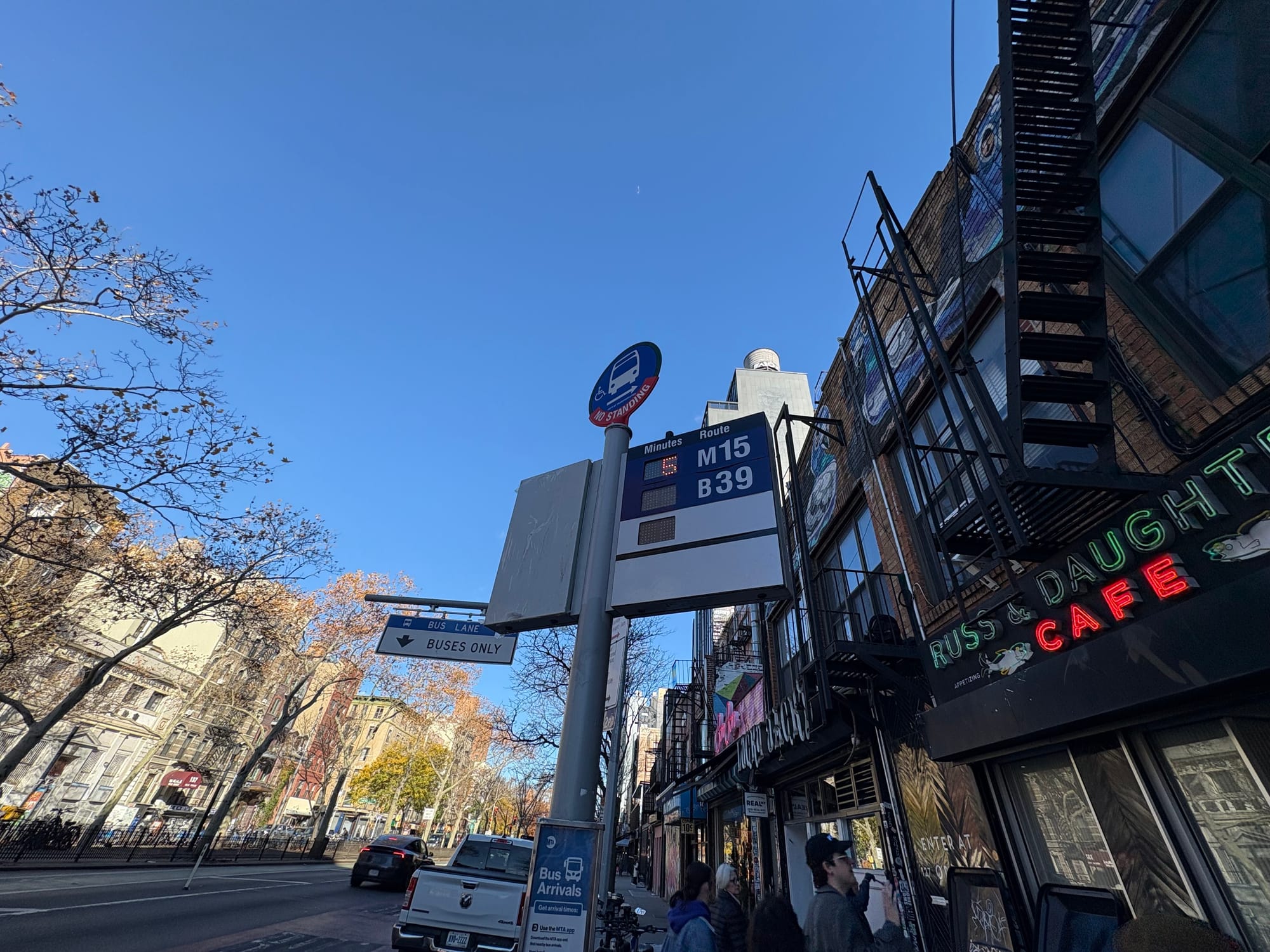
First rolled out in the 2010s, Bus Time is the MTA's real-time information system that provides bus ETAs. Onboard GPS hardware pings the MTA's server every few seconds, and the bus' location gets combined with route, stop, and schedule data. Then an algorithm comes up with predictions for when the bus will reach subsequent stops, and this information is fed to the MTA app and website, the separate Bus Time website, and the passenger information signs at bus stops.
And it's a mess.
Four current and former MTA employees with knowledge of the bus data—all of whom spoke to Hell Gate on condition of anonymity because they were not allowed to discuss their work publicly—attributed Bus Time issues to a combination of tough technical problems and a lack of institutional will to fix them.
They described the root problem as a complicated mix of old hardware and a "Frankenstein" software assembled haphazardly over many years. Among other things, Bus Time does not currently support real-time information on detours, instead supplying incorrect ETAs or nothing at all. Until recently the MTA did not even try to track bus reliability despite knowing it was an issue, according to a person with knowledge of Bus Time.
"Everyone who works on buses at the MTA knows that bus data is bad," said a former MTA employee. "It is one of those open secrets that is simultaneously acknowledged by everyone and measured by no one."
The current and former staffers said the quality of the GPS data needs improvement and new software has to be created to better interpret that data. That way, if a trip is canceled or a driver needs to stop for a bathroom break, the bus will register as being out of service instead of becoming a "ghost bus" that appears to be on its way before disappearing from your screen. (Mayor Mamdani himself referenced the "ghost bus" problem at a different bus announcement earlier this year: "I'm told the M60 is coming—nine minutes—it's about two minutes away; that bus disappears.")
The MTA sources said Bus Time's problems stem from bureaucracy just as much as technology.
Improvements to real-time bus information have been "deprioritized" in favor of providing additional bus service, according to an internal memo from 2025 obtained by Hell Gate.
The memo noted that Cambridge Systematics, the contractor that built and supported Bus Time for over a decade, told the MTA in 2024 it would be "exiting the business" of real-time information and would not bid on future contracts, leaving the transit agency in a tight spot.
"Running legacy software with reduced support that almost 3 [million] people depend on daily presents ongoing risk to the agency," the memo said.
A pilot program with a different vendor called Swiftly found that approximately 51 million bus rides each year could be improved by switching over, per the memo. The project was "quietly abandoned," according to a former MTA staffer.
"Buses are physical objects, and the MTA understands physical objects," they said. "Data is invisible, and the MTA does not know what to do with things it cannot see."
Tucked away in Mamdani and Hochul's bus action plan is a provision to "modernize" the backend data that feeds the MTA App and bus stop displays. MTA sources said Mamdani's larger bus push has provided the political momentum needed internally to finally tackle the bus data problem, and even expressed optimism about service improvements coming to Bus Time in the coming months.
The MTA has already started exploring how to improve GPS quality and software to address detours, ghost buses, and erratic ETAs, according to those familiar with the work.
"The MTA continually monitors and improves its prediction algorithms and underlying data to make arrival estimates more accurate and reliable," spokesperson Michael Cortez wrote in an email to Hell Gate, adding that the agency is "evaluating improvements" to the technology.
In the meantime, New York's bus riders are quite literally left waiting in the cold. The bus system is a crucial lifeline for disabled commuters and outer borough transit deserts. Bus riders are overwhelmingly people of color; they earn less money than their counterparts taking the subway or a car and are more likely to be immigrants, senior citizens or parents of young children.
"Bus riders are seen—incorrectly—as having time to waste," said Danny Pearlstein, policy and communications director at the transit advocacy group Riders Alliance. "Now that we have all this technology, our expectations are higher, but the technology isn't yet meeting our expectations."
Hundreds of complaints about the MTA app made between March and June, obtained by Hell Gate via public records request, detail the impossible transit calculus bus riders are forced to perform daily when they can't rely on the ETAs they're given.
New Yorkers described being stuck in the extreme heat and cold. They were late for work, forced to cancel medical appointments, losing jobs and money. They included parents, the disabled, workers on overnight shifts, even transit employees.
A straphanger in Yorkville recounted the arrival time for the M31 going from 44 minutes, to zero, to 35.
"It's now cold and late. If Uber and Lyft can track their cars, why can't [the] MTA?" they wrote in April. "Slowly getting fed up with wrong and lack of information. I won't care if you can't provide transport, but don't lie about it. This has happened to me too many times and trust is gone."
One complainant in Washington Heights mentioned regular issues tracking the BX7 with Bus Time in May.
"You have to decide: do I take another bus? How far is that stop? Can I make it? Should I take the train? Lyft? Wait and hope this bus really does show up anyway?" they wrote.
Individual frustrations aside, the unreliable bus data "means that people who should be riding transit choose not to, and that's a real problem," said Brian Fritsch, associate director of the Permanent Citizens Advisory Committee to the MTA. Fritsch said the loss of trust can contribute to more fare evasion and fewer riders.
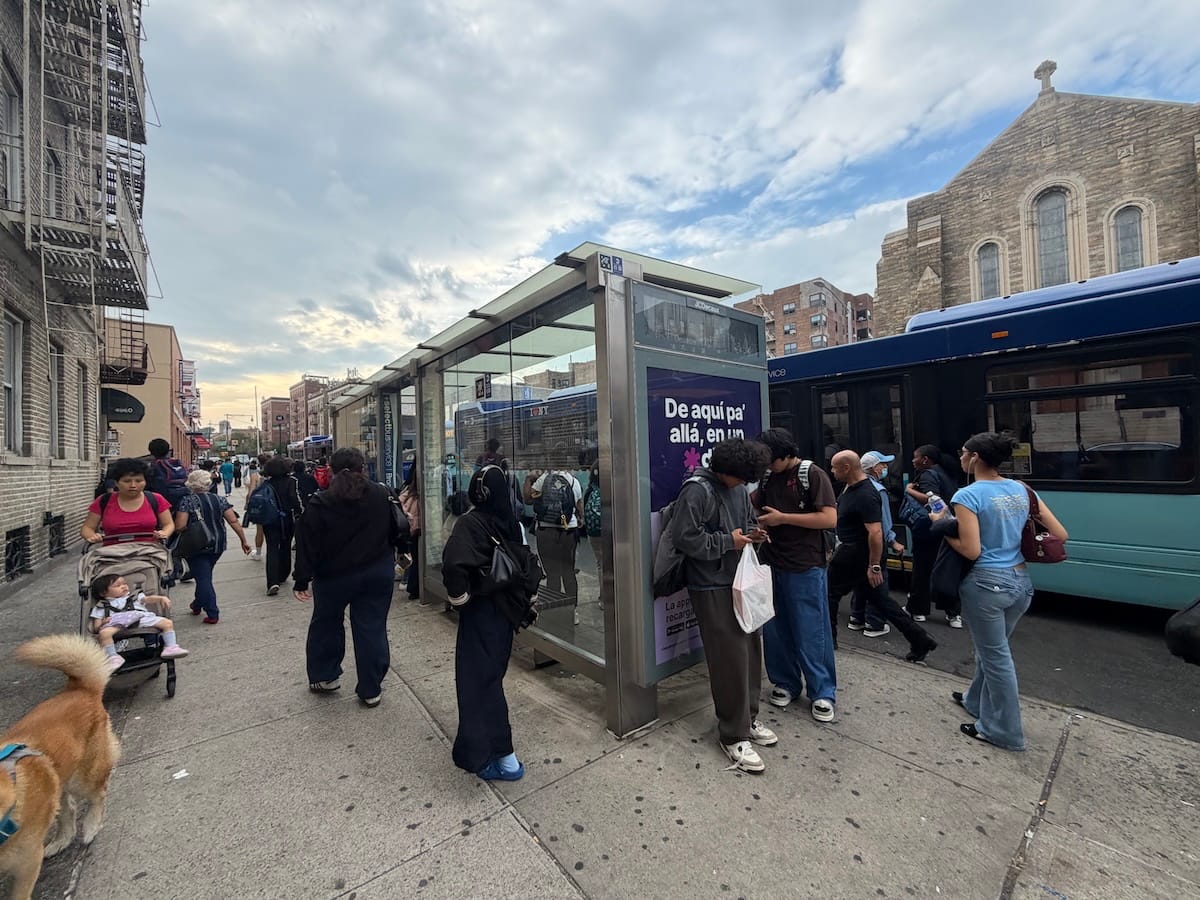
One such fed-up straphanger is George Rodriguez, a 26-year-old elevator service coordinator who lives in Mott Haven and commutes to Queens. He told Hell Gate he has issues "all the time" with the bus times for the M60 in Astoria—Mamdani's old bus—and that it often makes him late in the mornings. "It gets me frustrated because more often than not… the timing doesn't always tend to be accurate," he said.
Liz Cadeaux, 40, a content creator and stay-at-home mom in Crown Heights, said she would love to get rid of her car in favor of public transit but she "can't realistically do that" when service is so unreliable.
"This is a key tool for folks who have mobility issues to get around," said Cadeaux, who has a chronic illness and also schleps her toddler's stroller. "If it's unreliable, if it's not usable, if the times aren't real, then what's the point of it?"