




A.M. Gittlitz can remember his very first Mets game at Shea Stadium, when he watched Mr. Met beat Barney the Dinosaur with a baseball bat.
The year was 1994, the Mets were playing the Giants, and Gittlitz recalled how fans heartily booed Barney's appearance on the field just before Mr. Met lowered the boom: "Even back then, that was a little disturbing to me."
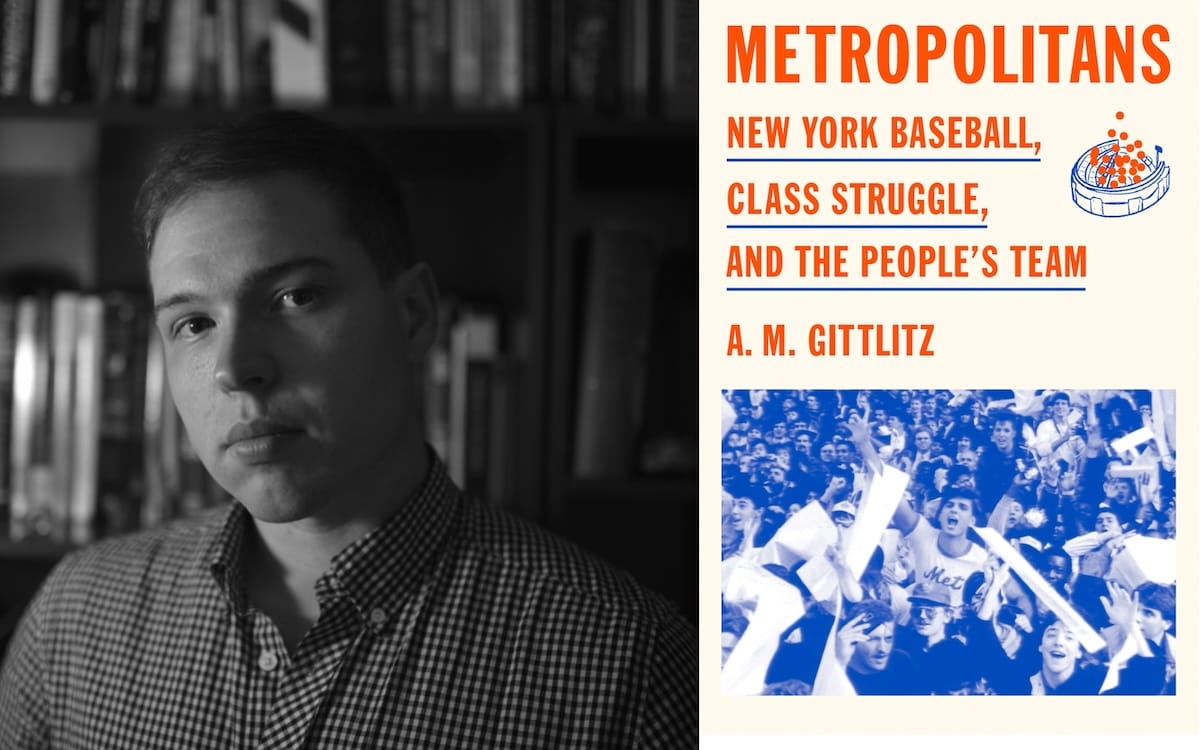
This darkly comic incident was foundational for Gittlitz's lifelong Mets fandom that is culminating in the release of his new book, "Metropolitans: New York Baseball, Class Struggle, and the People’s Team," which comes out this week.
The book tracks America's pastime in America's largest city, from the Elysian Fields to Steve Cohen, highlighting how labor politics, the left, and progressivism are intertwined with the identity of Queens's lovable losers. "When the political moment in the city connects with the Mets, I think that's when they have their greatest years," Gittlitz told me.
I met Gittlitz at Lou's Athletic Club, a bar in Bushwick, Brooklyn that he described as "a punk bar for sports, or a sports bar for punks." Lou's plays a central role in the final section of "Metropolitans," as the book shifts from historical study of the team's political ebbs and flows to Gittlitz's first-person account of the 2024 "Gay Grimace Mets" and their unconventional playoff run.
We spoke about the team's pre-history, why the love of the Brooklyn Dodgers endured but the New York Baseball Giants did not, and Mets fans' enduring enthusiasm "in the face of near-certain defeat."
This interview has been lightly edited for length and clarity.
Hell Gate: Your book tracks the history of the team, but you don't start in 1962 or even 1957. You go all the way back to the Elysian Fields and the Civil War. Why, for a book about the history of the Mets, did you want to start with so much of the Mets' prehistory?
AM Gittlitz: I pitched it in a way that could go either way, like a history of baseball in New York or a Mets history, and they really liked the Mets history idea. But I found that to explain baseball as being political, you do have to sort of go back to its origins. It does begin with a chapter about The Metropolitans, the 1880 Metropolitans. But even that begins, you're right, at 1776. And so I think a lot of readers might be a little bit thrown off by that, like, get to the Mets already, or get to the Mets that I know and love.
But I did want to create this sort of general theory about baseball the way that C.L.R. James did with cricket in "Beyond a Boundary." That was a major inspiration for this book. And to do that, I wanted to understand baseball sort of structurally, like what people talk about as being this American sport, the American pastime. I wanted to understand what that really meant.