



New York City's housing affordability crisis is an existential threat to the self-professed greatest city in the world. And while tenant organizers and mayoral candidates fight to protect the existing affordable housing we have, the need to build more is also acute. The city currently has a shortage of roughly 500,000 apartments, and the current pace of construction—25,000 units per year—isn't enough to meet the demand.
With an eye toward building more housing, a City charter review commission convened by Mayor Eric Adams (by far the more legit of the two commissions he has created) has put three housing-related questions on the November ballot for voters to weigh in on. (You'll also be voting on other measures, like possibly moving local elections to presidential years, building on an upstate forest preserve, and consolidating all the official City maps.)
The controversial housing questions—Propositions 2, 3, and 4—have the support of a slate of notable elected officials—including Comptroller Brad Lander, Brooklyn Borough President Antonio Reynoso, and Manhattan Borough President Mark Levine—as well as YIMBY think tanks and a PAC, which has vowed to spend $3 million to get the measures passed. According to one of the donors to the PAC, the measures would "have a tremendous impact on solving the housing crisis."
Sounds reasonable! But at the same time, the City Council has waged a campaign to convince New Yorkers that these three ballot measures would mark a return to the kind of top-down, scorched-earth development of the Robert Moses era, where communities would lose their hard-won power accrued over decades to make reasonable demands from the powerful real estate industry.
During a press conference last week, Bronx City Councilmember and Majority Leader Amanda Farías called the housing-related ballot measures "a blatant power grab that would strip communities of their power and voice in decisions about development in their neighborhoods." City Council Speaker Adrienne Adams put it even more apocalyptically: "There will be no more negotiation with our residents, with our neighbors, with our community boards, with our civic associations that we partner with. That will be gone. That's off the table if these proposals go through." To drive their argument home, Adams and the council sent paper fliers to voters telling them that the props will create "more gentrification" and "less affordability," skirting right up to the line of illegal electioneering.
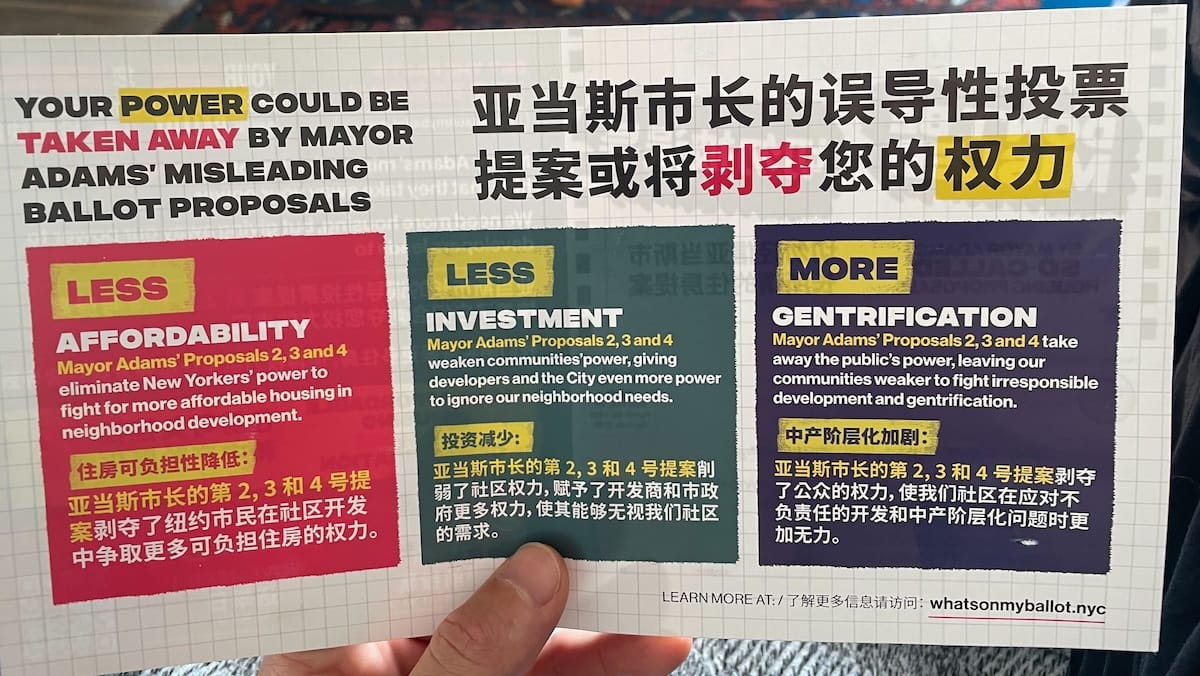
So what's a voter to think? Are these three ballot props a tonic straight out of "Abundance" that will kickstart a housing boom and drive down rents? Or do they eliminate the public review process as we know it, and hand the keys to the city over to real estate developers?
Subscribe to read the full story
Become a paid subscriber to Hell Gate to access all of our posts.
Subscribe